Choosing the Right Dial Indicator: A Comprehensive Guide

Choosing the Right Dial Indicator
Introduction to Dial Indicators
Dial indicators are essential tools in precision measurement, widely used in manufacturing and engineering to ensure that machined parts meet exact specifications. These instruments measure small distances or angles, playing a crucial role in tasks such as aligning machinery, checking runout, and verifying tolerances. Selecting the right dial indicator is vital for achieving accurate measurements and optimizing your processes.
The History of Dial Indicators
The development of the dial indicator dates back to the early 20th century, with the first commercial versions emerging around 1916. The invention is credited to Warren A. Marrison, who aimed to create a reliable tool for precise measurement. Initially, dial indicators were entirely mechanical, relying on gears and springs to translate small movements into readable measurements on a dial. These early indicators revolutionized precision measurement, becoming a staple in manufacturing and engineering.
Types of Dial Indicators Used in Manufacturing
Over the years, dial indicators have evolved to meet various needs in manufacturing. Here are the most common types:
- Standard Dial Indicators
- Description: These are the most common dial indicators, featuring a round dial with a needle that moves in response to the probe's displacement.
- Use: Standard dial indicators are used for measuring flatness, alignment, and runout in various applications, including machining and assembly.
- Test Indicators
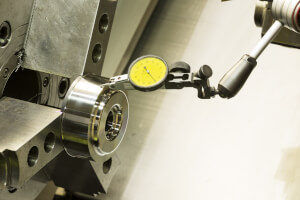
- Description: Test indicators have a lever-type probe that moves perpendicularly to the surface being measured, making them ideal for measuring small angles and tight spaces.
- Use: Often used in precision machining and tool setup, where measurements need to be taken in confined or hard-to-reach areas.
- Plunger-Style Dial Indicators
- Description: These indicators use a spring-loaded plunger that retracts into the body of the indicator as it contacts the workpiece.
- Use: Commonly used for measuring linear displacement and ensuring that parts are within specified tolerances.
- Back Plunger Indicators
- Description: The plunger is located at the back of the indicator, allowing it to be mounted on flat surfaces or in tight spaces.
- Use: Ideal for applications where space is limited or where the indicator needs to be mounted in a specific orientation.
Modern Dial Indicators: Digital and Automatic
As technology has advanced, so too have dial indicators. Modern indicators now include digital and automatic versions that offer enhanced accuracy, ease of use, and data integration capabilities.
- Digital Dial Indicators
- Description: These indicators feature an electronic display that shows measurements digitally, eliminating the need for manual reading.
- Advantages: Digital indicators provide higher accuracy, easy-to-read displays, and the ability to switch between measurement units (e.g., inches and millimeters). They often include functions like presetting, zeroing, and data output to computers or data loggers.
- Use: Widely used in quality control, inspection processes, and environments where precise and repeatable measurements are critical.
- Automatic Dial Indicators
- Description: These are sophisticated tools that automate the measurement process, often integrating with CNC machines or other automated systems.
- Advantages: Automatic indicators reduce human error, increase efficiency, and allow for continuous monitoring and real-time feedback during manufacturing processes.
- Use: Commonly found in automated production lines, where consistent and accurate measurements are necessary for maintaining quality and reducing waste.
How to Choose the Right Dial Indicator
When selecting a dial indicator, consider the following factors:
- Accuracy Requirements: Determine the level of precision needed for your application. Digital indicators generally offer higher accuracy than mechanical ones.
- Measurement Range: Ensure the indicator has a suitable measurement range for the dimensions you need to check.
- Environment: Consider the working environment. For example, digital indicators are more sensitive to dust and moisture, so choose accordingly if working in harsh conditions.
- Ease of Use: Consider how easy the indicator is to set up, read, and use. Digital models offer convenience, while mechanical models are robust and straightforward.
- Data Integration: If you need to log measurements or integrate them into a digital system, a digital or automatic dial indicator with data output capabilities is ideal.
Conclusion
Dial indicators are critical tools in precision measurement, offering reliability and accuracy across various applications in manufacturing and engineering. Whether you opt for a standard mechanical dial indicator or a modern digital or automatic model, choosing the right one will ensure that your measurements are accurate and your processes run smoothly. Understanding the different types and their applications will help you make an informed decision, optimizing your operations for quality and efficiency.