Why a CNC Machine Is Not a Robot: Key Differences Explained

Why a CNC Machine Is Not a Robot: Key Differences Explained
In today's high-tech manufacturing world, CNC machines and robots are often seen working side-by-side on factory floors. With both automating tasks and improving efficiency, many people ask: “Is a CNC machine a robot?”
The short answer is no—a CNC (Computer Numerical Control) machine is not a robot.
Although they share some similarities, CNC machines and industrial robots serve fundamentally different purposes. This article breaks down the key differences between CNC machines and robots, and why it matters for modern manufacturing.
🤖 What Is a Robot?
A robot is a programmable mechanical device that can perform a variety of tasks, often with multiple degrees of motion and some level of decision-making or environmental interaction.
Key Characteristics of a Robot:
- Multi-purpose: Can be reprogrammed for different tasks (e.g., welding, assembly, packaging)
- Flexible movement: Often has multiple axes of rotation (e.g., robotic arms)
- Sensor integration: Can "see" or "feel" its environment using cameras or force sensors
- Artificial intelligence: Some use AI for decision-making and adaptive behavior
🛠️ What Is a CNC Machine?
A CNC machine is a manufacturing tool controlled by computer code (G-code) to cut, drill, mill, or shape solid materials with precision.
Key Characteristics of CNC Machines:
- Purpose-built: Designed for specific tasks like milling, turning, or laser cutting
- Rigid programming: Executes exact instructions, not adaptable on the fly
- No environmental awareness: Lacks cameras, sensors, or autonomy
- Fixed path: Follows a pre-programmed tool path with precision
🔍 Key Differences Between CNC Machines and Robots
| Feature | CNC Machine | Robot |
|---|---|---|
| Function | Material removal or shaping | Handling, assembly, inspection, etc. |
| Programming | G-code for fixed machining paths | More dynamic and flexible scripting (e.g., ROS, RAPID) |
| Flexibility | Highly specialized for one task | Can be reprogrammed for various tasks |
| Sensors/AI | Rarely includes sensors | Often includes vision systems, force sensors, etc. |
| Mobility | Stationary and rigid | Often mobile or with flexible joint movement |
| Example Use | Milling a titanium aerospace part | Picking and placing products on a conveyor |
🧠 CNC = Automation. Robot = Autonomy.
The key distinction comes down to automation versus autonomy:
- CNC machines automate a very specific set of tasks with high precision, but they do not adapt or respond to changing environments.
- Robots can autonomously interact with their surroundings and make real-time adjustments—often across a broader set of tasks.
🤝 How CNC Machines and Robots Work Together
In advanced manufacturing, CNC machines and robots are not competitors—they're teammates.
Example:
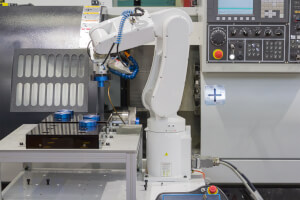
- A robotic arm loads raw material into a CNC lathe.
- The CNC machine precisely machines the part.
- A second robot removes the part, inspects it, or packages it.
This collaboration increases throughput, reduces human labor, and boosts consistency.
🏭 Use Cases: CNC vs. Robot
| Industry | CNC Machines | Robots |
|---|---|---|
| Aerospace | Machining high-tolerance parts | Material handling & inspection |
| Automotive | Engine block milling | Welding car frames |
| Medical | Creating surgical implants | Assembling small components |
| Electronics | Milling enclosures | Pick-and-place surface mount devices |
🔚 Conclusion: CNC Machines Are Not Robots—They’re Precision Tools
While both CNC machines and robots are integral to smart factories, they serve very different roles.
- CNC machines are built for precision machining, following strict paths without deviation.
- Robots are flexible, adaptable tools that handle, inspect, and interact dynamically with their environment.
Understanding this distinction helps businesses invest wisely in the right automation technology—and ensures you're not expecting a CNC to do a robot's job.