From Reliability to Efficiency: The Rise of Energy-Centered Maintenance (ECM)

From Reliability to Efficiency: The Rise of Energy-Centered Maintenance (ECM)
Manufacturers face a dual challenge that defines today’s industrial era: reducing unplanned downtime while simultaneously lowering energy costs and meeting aggressive sustainability targets. Every unplanned outage ripples through production schedules, but even machines that stay online can quietly drain profits — and power — when operating below optimal efficiency.
The Hidden Cost of “Reliable but Wasteful” Machines
Traditional Reliability-Centered Maintenance (RCM) has long been the standard for ensuring uptime and extending equipment life. Its core objective is straightforward: prevent failure. Yet in its focus on mechanical reliability, RCM often overlooks a critical blind spot — the energy inefficiency of faulted equipment.
When motors, compressors, or pumps operate outside their designed condition — whether from worn bearings, misalignment, or flow restrictions — they can consume up to 20% more electricity without any immediate alarm triggering. Across a large facility, that hidden waste translates into massive operational costs and excess carbon emissions.
Introducing Energy-Centered Maintenance (ECM)
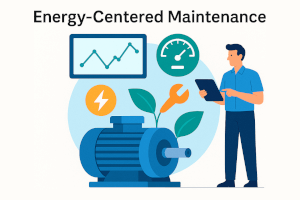
To bridge the gap between reliability and sustainability, forward-thinking manufacturers are now adopting Energy-Centered Maintenance (ECM) — a next-generation strategy that unites predictive maintenance with real-time energy optimization.
ECM builds on the predictive principles of RCM but adds a new dimension: continuous monitoring of energy-related parameters that reflect machine health and efficiency. By tracking power factor, current harmonics, torque fluctuations, and vibration profiles, ECM can pinpoint early signs of both mechanical degradation and energy inefficiency long before failure occurs.
How ECM Works in Practice
For rotating equipment such as pumps, fans, and CNC spindle drives, ECM uses smart sensors and analytics to:
- Detect early inefficiencies — Identifying subtle power draw changes that indicate imbalance, friction, or load misalignment.
- Predict and prevent failures — Using correlated data across vibration, current, and temperature signals to forecast failure modes.
- Optimize performance and emissions — Recommending corrective actions that restore peak operating efficiency and minimize energy loss.
The result is a shift from reactive or even predictive maintenance to proactive efficiency management, where energy consumption itself becomes a key health indicator.
The Payoff: Uptime Meets Sustainability
Implementing ECM can deliver measurable impact in three critical areas:
- Energy Cost Reduction: Up to 15–25% energy savings by maintaining optimal performance and eliminating hidden waste.
- Reliability Gains: Earlier detection of faults reduces downtime and extends component life.
- Sustainability Reporting: Quantifiable reductions in electricity use translate directly into lower greenhouse gas emissions and improved ESG metrics.
By merging maintenance data with energy analytics, ECM empowers manufacturers to achieve what was once seen as a trade-off — maximizing uptime while minimizing environmental impact.
The Future of Smart Maintenance
Energy-Centered Maintenance represents the evolution of reliability — from a focus on avoiding failures to a mission of optimizing every watt of energy that flows through a plant. As digital twins, IoT platforms, and AI-driven diagnostics become standard, ECM will serve as the unifying layer that connects operational excellence with sustainability.
For manufacturers striving to compete in a high-cost, low-carbon future, ECM isn’t just another acronym — it’s the foundation of the next industrial revolution.