Global CNC Machine Market Outlook: On Track to Exceed $200 Billion by 2034


Global CNC Machine Market Outlook: On Track to Exceed $200 Billion by 2034
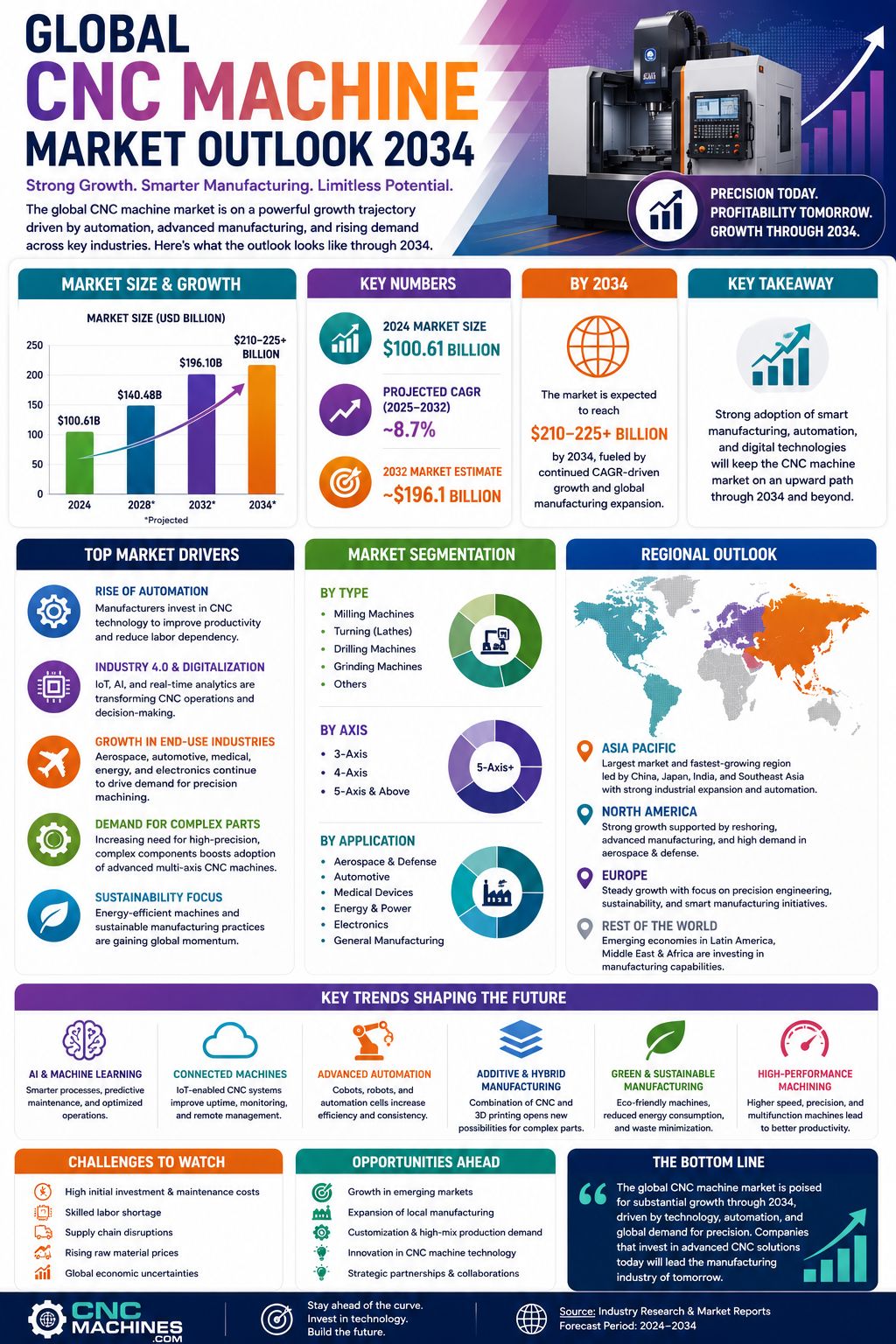
The global CNC machine market continues to demonstrate strong, durable growth as manufacturers worldwide accelerate automation, precision engineering, and digital transformation initiatives. Valued at $100.61 billion in 2024, the CNC market is projected to nearly double over the next decade, with expectations of exceeding $200 billion by 2034.
From the perspective of cncmachines.com, this sustained expansion reinforces one clear reality: CNC equipment remains a foundational asset in modern manufacturing, driving productivity, consistency, and long-term competitiveness across industries.
CNC Market Growth at a Glance
- 2024 Market Size: $100.61 billion
- Projected CAGR (2025–2032): ~8.7%
- 2032 Market Estimate: ~$196.1 billion
- 2034 Market Expectation: $210–225+ billion (continued CAGR-driven growth)
This growth is fueled by rising demand across automotive, aerospace & defense, medical devices, electronics, energy, and industrial machinery, where tighter tolerances and repeatable accuracy are non-negotiable.
CNC Market Size Forecast (CAGR-Based Projection)
| Year | Estimated Market Size (USD) | Key Drivers |
|---|---|---|
| 2024 | $100.6B | Automation adoption, reshoring, precision demand |
| 2026 | $119–122B | Smart factories, labor shortages |
| 2028 | $141–145B | AI-enabled machining, IIoT integration |
| 2030 | $168–172B | Multi-axis growth, aerospace & medical demand |
| 2032 | ~$196.1B | Industry 4.0 maturity |
| 2034 | $210–225B+ | Sustainability mandates, digital twins, global capacity expansion |
Estimates based on sustained CAGR with moderate acceleration from AI-driven manufacturing.
Why CNC Machines Remain Essential to Modern Manufacturing
CNC (Computer Numerical Control) machines rely on programmed software to automate machining operations with extreme precision. Compared to manual machining, CNC systems deliver:
- Higher accuracy and repeatability
- Faster production cycles
- Lower scrap and rework rates
- Reduced reliance on manual labor
- Scalable output for high-mix, low-volume and mass production
CNC machines are now standard across:
- Milling and turning
- Drilling and grinding
- Laser and plasma cutting
- Electrical Discharge Machining (EDM)
At cncmachines.com, this versatility is a major reason used CNC machines retain long-term resale value and remain in constant demand.
Industry 4.0 Is Reshaping CNC Technology
The CNC market is no longer defined by iron alone. Today’s growth is driven by connected intelligence:
- AI-powered analytics for tool wear detection
- Industrial IoT (IIoT) for real-time machine monitoring
- Digital twins for simulation and optimization
- Advanced CAD/CAM integration to reduce setup time
These innovations transform CNC machines into smart production assets, capable of predictive maintenance, automated parameter adjustment, and continuous performance improvement.
Regional Market Momentum
North America
- Strong aerospace & defense demand
- Reshoring and near-shoring initiatives
- Early adoption of automation and AI
Asia-Pacific
- Rapid industrialization
- Export-driven manufacturing growth
- Government-backed automation programs
Europe
- Leadership in precision engineering
- Sustainability-focused manufacturing
- Industry 4.0 and Green Deal alignment
Together, these regions account for the majority of global CNC machine investment and secondary-market activity.
Sustainability Is Accelerating CNC Investment
Environmental compliance is now a core purchasing factor. Compared to conventional machining, CNC systems offer:
- Optimized tool paths that reduce material waste
- Higher energy efficiency via modern servo drives
- Regenerative braking and lower idle consumption
- Improved coolant and filtration technologies
For manufacturers under pressure to reduce emissions, upgrading CNC equipment—new or used—has become a practical sustainability strategy.
Policy Support and Manufacturing Incentives
Global policy initiatives are reinforcing CNC market momentum:
- U.S. reshoring and domestic manufacturing incentives
- India’s “Make in India” program
- China’s advanced manufacturing roadmap
- Europe’s Industry 4.0 and Green Deal policies
At the company level, investments in digital factories, workforce training, and automation partnerships continue to unlock productivity gains and reduce long-term operating costs.
Technology Trends Driving Premium CNC Demand
- Rising adoption of 5 Axis CNC Mill and multi-axis CNC machines
- AI-driven CAM software for faster programming
- Cloud-based machine monitoring and analytics
- Automated inspection and closed-loop feedback
These technologies are especially critical in aerospace, defense, and medical manufacturing, where complexity and tolerances continue to tighten.
Market Challenges to Watch
Despite strong growth, barriers remain:
- High upfront capital costs for advanced CNC systems
- Ongoing maintenance and service requirements
- Skilled labor shortages in emerging markets
- Infrastructure limitations in developing regions
This is where the secondary CNC market plays a vital role, helping manufacturers access advanced equipment at lower total cost of ownership.
Leading CNC Manufacturers Driving Innovation
Global OEMs continue to invest heavily in connected, energy-efficient CNC platforms, including DMG MORI, Yamazaki Mazak, Haas Automation, FANUC, Siemens AG, and Okuma Corporation.
Industry activity continues to highlight this direction, including AI-based CAM software launches, energy-efficiency retrofit programs, and strategic automation partnerships across the U.S., Europe, and Asia.
What This Means for Buyers and Sellers on CNCmachines.com
As the CNC market moves beyond $200 billion, demand for both new and used CNC machines will remain strong. For sellers, this creates favorable resale conditions. For buyers, it reinforces the value of investing in proven equipment that aligns with automation and sustainability goals.
At cncmachines.com, we see this growth firsthand—driven by manufacturers who understand that CNC technology is not cyclical hype, but long-term infrastructure for global production.