Streamlining Tool Setup for CNC Machines: Eliminating Human Error With Modern Tooling Technology

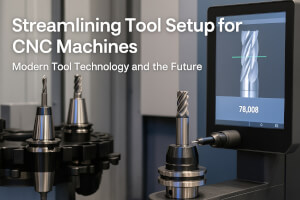
Streamlining Tool Setup for CNC Machines: Eliminating Human Error With Modern Tooling Technology
CNC machining has never been more advanced—or more demanding. As tolerances tighten, materials get tougher, and lead times shrink, the smallest setup mistake can cost thousands in scrap, downtime, or damaged spindles. Many shops still rely heavily on manual tool setting practices: hand-measuring stickout with calipers, eye-balling tool lengths, or relying on tribal knowledge to determine offsets.
But the modern era of tooling is shifting fast. Automated tool measurement, real-time tool life prediction, digital tool libraries, and connected tool management systems are changing the game entirely. The mission is clear: reduce human error, increase repeatability, and build consistent machining performance across every shift.
This article breaks down what tool setup looks like today, where the biggest risks come from, and how next-gen tooling solutions will reshape machining over the next decade.
The Problem: Tool Setup Is Still One of the Biggest Sources of Error
Even the best machining cells suffer from occasional operator-introduced issues during tool setup:
Common Causes of Tool-Setup Errors
- Incorrect tool length or diameter measurement
- Wrong tool loaded in wrong pot
- Improper stickout leading to chatter or breakage
- Worn tools reintroduced as “good”
- Missing edge prep or incorrect insert grade
- Incorrect tool offset entry in the control
- Lack of documentation across shifts
- Tools measured differently by different operators
- Tool life inconsistencies due to manual judgment
Every one of these errors compounds as production scales. In high-mix shops, where tools change out dozens of times per day, this becomes a major risk to quality and delivery.
The Modern Solution: Technology That “Removes the Human” From Tool Setup
Over the past five years, the tooling industry has seen explosive innovation focused on setup automation, metrology precision, digital twins, and predictive analytics.
Here are the technologies that define modern tool setup:
1. Offline Tool Presetters (Manual → Fully Automated)
Tool presetters have become the backbone of accurate, repeatable CNC setup. Modern systems eliminate manual measurements entirely:
Key Features
- High-resolution cameras for edge detection
- Automated Z/L/D measurement to microns
- RFID / Data Matrix tool ID encoding
- Closed-loop spindle taper inspection
- Collision simulation before tools reach the machine
- Automatic tool-offset import into machines (no typing errors)
Why It Matters
A CNC operator no longer decides the measurement—the presetter does. This alone eliminates the largest category of setup mistakes.
Top OEMs: Zoller, Haimer, Speroni, Kelch, Parlec
2. Digital Tool Libraries + Tool Identification (RFID, QR, Laser Marking)
Tooling mistakes often occur simply because tools look similar. RFID-tagged and laser-marked tools bring digital identity to every cutter.
Benefits
- Every tool has a digital fingerprint
- CNC machines verify the tool ID before running
- Automatic loading of correct offsets and parameters
- Eliminates wrong-tool-in-wrong-pocket failures
This is becoming the new standard for aerospace and medical machining.
3. Tool Breakage Detection + In-Machine Lasers
Advanced machine tools now include:
- Laser tool setters (contactless)
- Integrated camera systems
- Tool probes for length/diameter
- Software that checks for broken tools automatically
This dramatically reduces scrap by detecting tool wear or breakage before the next part cycle begins.
4. Tool Life Monitoring & Predictive Analytics
Shops are moving from fixed tool life (ex: “change every 20 minutes”) to AI-enhanced tool-life prediction based on real cutting data.
Modern tool life tracking includes:
- Cutting load variance
- Spindle power trends
- Temperature and vibration data
- Insert edge wear analysis
- Material behavior patterns
- Tool-path optimization feedback
- Real-time adjustments in feed/speed
- Automated tool change triggers
The result: Tools last longer, fail less, and stay consistent across shifts—without relying on operator judgment.
5. Digital Twins for Tools, Tool Holders & Assemblies
CAM systems (Mastercam, Autodesk, SolidCAM, hyperMILL) now use tool assembly digital twins with exact geometry for:
- Collision detection
- Holder clearance simulation
- Reach and stickout optimization
- Toolpath verification
- Chip load accuracy
This drastically reduces trial-and-error and ensures that the tool setup on the bench mirrors the digital environment.
Current Technology vs The Future: What’s Coming Next
The next decade of tooling will push automation even further:
1. Autonomous Tool Setup Stations
Think of it like a “pit crew” for tools:
- Robots load tools
- Automated cleaning & taper inspection
- Automatic runout compensation
- AI verifies correct length, diameter, and geometry
- Tools are stored in intelligent cabinets with real-time inventory
This is already happening in Europe and Japan, and is coming quickly to U.S. shops.
2. AI-Driven Tool Wear Detection
Using thermal imaging + acoustic sensors + spindle power signatures, AI will soon:
- Identify insert chipping within seconds
- Predict remaining tool life to the exact minute
- Detect unstable cutting before it becomes chatter
- Recommend new cutting parameters on the fly
This turns every CNC into a “self-learning machining system.”
3. Real-Time Tool Testing
Tool manufacturers are developing methods to:
- Auto-test tools on micro cutting stations
- Grade carbide batches with AI scoring
- Generate tool performance certificates
- Adjust geometry for specific materials in real time
This will ensure every tool performs identically—something impossible today.
4. Fully Connected Tool Ecosystems
Imagine:
- Tool presetters talking to CNC controls
- Tooling cabinets reporting inventory
- CAM software updating feed/speed recommendations based on wear
- Machines automatically adjusting based on real runtime data
This will eliminate 90% of tool-related setup errors.
How Shops Can Start Today (Practical Steps)
You don’t need a $500,000 automation cell to improve tool setup. Start with these steps:
Level 1: Immediate Improvements
- Use dedicated tool carts and standardized tool sheets
- Implement preset tool lengths for common jobs
- Use digital calipers & height gauges instead of analog
- Create documentation for stickout standards
Level 2: Modernization
- Invest in a basic tool presetter
- Add tool breakage detection to machines
- Implement barcoded tool IDs
- Standardize holders and shrink-fit assemblies
Level 3: High-End Automation
- Adopt an automated presetter with RFID
- Use digital twins for all tool assemblies
- Implement tool life monitoring software
- Connect presetters to CNCs to eliminate manual offset entry
- Add spindle load monitoring for predictive wear analysis
Level 4: Future-Ready Smart Tooling
- Integrate AI-driven tool wear systems
- Use automated tool changing robots for offline setup
- Deploy cloud-based tool libraries across multiple facilities
Conclusion: Tool Setup Is Becoming a Science, Not an Art
The days of “feel,” intuition, or tribal knowledge being good enough are ending. With material costs rising, delivery timelines tightening, and skilled labor becoming harder to find, shops must eliminate human error from tool setup entirely.
Modern tooling technology—presetters, digital IDs, connected machines, AI wear detection, and predictive analytics—is transforming CNC machining from a manual, operator-driven process into a fully controlled, data-driven workflow.
Shops that embrace these changes will enjoy:
- Fewer crashes
- Higher tool life
- Increased repeatability
- Faster setups
- Consistent results across all shifts
- Higher margins with lower scrap
The future is clear: Smart tooling isn’t optional—it will be the foundation of competitive manufacturing over the next decade.