The Rise of Domestic Manufacturing in 2026: Why U.S. CNC Shops Are Getting More Work

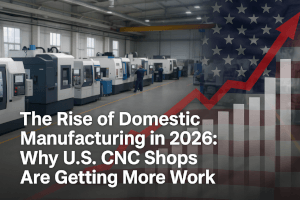
The Rise of Domestic Manufacturing in 2026: Why U.S. CNC Shops Are Getting More Work
In 2026, something remarkable is happening across the American manufacturing landscape. CNC shops that once struggled to compete with low-cost overseas production are suddenly busier than they have been in more than a decade. Job shops from Ohio to Texas to California report record quoting activity, fuller schedules, and a surge in new customers looking to reshore critical parts and assemblies.
A Changed World: How 2020–2025 Set the Stage for 2026
The United States spent decades watching production migrate overseas. But the disruptions of 2020–2025 exposed a harsh truth: outsourcing critical manufacturing is a risk, not a cost savings strategy.
1. Global Supply Chain Fragility Became Impossible to Ignore
Shipping delays, port congestion, geopolitical conflicts, pandemics, and material shortages showed OEMs that relying solely on overseas suppliers is dangerous. Lead times that once took 6–8 weeks ballooned into 20–40 weeks or longer.
2. True Cost of Outsourcing Surpassed the Advertised Cost
Companies began calculating Total Cost of Ownership, including:
- Quality failures
- Shipping uncertainty
- Minimum order quantities
- Lost production time
- Communication delays
- Intellectual property risk
- Tariffs and duties
Once all factors were included, domestic sourcing was often cheaper than offshore.
3. Critical Industries Needed Supply Chain Security
Aerospace, defense, medical, semiconductor, clean energy, and EV manufacturers began prioritizing localized, redundant, resilient supply chains. By 2026, reshoring is no longer a trend. It is a strategic imperative.
Government Policies Fuel the Manufacturing Comeback
Federal initiatives have accelerated domestic manufacturing growth at a pace not seen in decades.
1. CHIPS Act and Semiconductor Expansion
Billions in investment have poured into U.S. semiconductor fabs, and every fab requires:
- Precision machining
- Tooling
- Fixtures
- Cleanroom compatible components
CNC shops are direct beneficiaries.
2. Defense Spending and CMMC 2.0 Compliance
The DoD has expanded U.S.-based procurement for security reasons. American CNC job shops certified under CMMC 2.0 are receiving priority on RFQs that were once awarded offshore.
3. Manufacturing Tax Credits and Automation Incentives
New Section 179 benefits, R&D credits, and state-level grants have encouraged more OEMs to expand domestic production capacity—creating more job shop demand.
4. “Made in USA” Consumer and OEM Preference
Domestic production has become a competitive advantage. Brands proudly advertise it, and customers reward it.
Why CNC Shops Specifically Are Winning in 2026
While manufacturing in general is rising, CNC shops are seeing the sharpest and fastest increase in demand. There are five major reasons.
1. Precision Parts Have Become a Strategic Asset
Modern industries require parts with tolerances that offshore competitors often cannot achieve reliably or consistently. This includes:
- Aerospace components
- Medical implants
- Semiconductor tooling
- Nuclear energy parts
- Defense-critical machined assemblies
OEMs can no longer risk inconsistency or delays on parts that are mission-critical.
2. Speed Matters More Than Price
In 2026, speed to market matters more than ever. OEMs want:
- Faster prototyping
- Faster production runs
- Faster engineering changes
- Faster supplier communication
U.S. CNC shops offer:
- Same-day response
- Local engineering support
- Face-to-face problem solving
- Faster logistics and shipping
Domestic responsiveness now outweighs price differences.
3. Automation Has Closed the Labor Cost Gap
Automation adoption has skyrocketed. Three trends made domestic CNC machining competitive again:
- 5-axis and Swiss automation
- Pallet systems enabling lights-out machining
- Advanced CAM and simulation tools reducing setup time
A highly automated U.S. shop can match or outperform overseas pricing because labor cost is no longer the primary driver of total cost.
4. AI-Driven Quoting Is Making U.S. Shops More Competitive
Tools like Time on Machine estimators, automated feature detection, and quoting engines (including those used by CNCmachines.com sellers) allow shops to:
- Quote faster
- Price accurately
- Increase win rates
- Eliminate human error
AI has given small and mid-sized CNC shops the ability to compete with large global manufacturers on efficiency and intelligence.
5. OEMs Prefer Fewer, Higher-Quality Domestic Suppliers
OEM procurement teams now value supplier relationships more than vendor count. They want shops that can:
- Collaborate
- Communicate
- Iterate
- Scale quickly
American CNC shops excel in exactly these capabilities.
Key Industries Driving the 2026 Manufacturing Boom
Multiple industries are expanding production in America simultaneously, creating unprecedented CNC demand.
1. Aerospace & Space Exploration
Boeing, SpaceX, Blue Origin, Lockheed Martin, and NASA suppliers are increasing domestic machining needs for:
- Titanium parts
- Flight components
- Rocket engine hardware
- High-precision assemblies
2. Defense and Military
U.S. national security depends on domestic machining capability. This sector is growing at its fastest rate in 20 years.
3. Semiconductor Fabrication
Every semiconductor fab requires millions of dollars in precision machined components annually.
4. Medical Devices
FDA-regulated industries prefer domestic suppliers due to quality and traceability requirements.
5. Electric Vehicles and Renewables
EV drivetrains and energy systems rely heavily on machined aluminum, steel, copper, and composite tooling.
Why Buyers Are Switching to Domestic CNC Shops Permanently
Even if global supply chains stabilize, OEMs are unlikely to return to their old sourcing habits. Key reasons include:
1. Risk Reduction
Supply chain diversification is now part of corporate strategy.
2. Quality Assurance
Domestic QC standards are significantly higher.
3. Intellectual Property Protection
IP theft is a multi-billion-dollar problem overseas.
4. Smaller Minimum Order Quantities
U.S. shops allow flexibility and iterative development.
5. Greater Engineering Collaboration
Communication barriers slow product development. Domestic suppliers solve this.
How CNC Shops Can Capitalize on the Boom in 2026
This resurgence is a rare opportunity. Shops that move quickly will secure long-term advantages.
1. Invest in Automation
Even a single pallet system or cobot can double throughput.
2. Adopt AI-Powered Quoting
The faster the quote, the higher the win rate.
3. Improve Digital Presence
Buyers expect:
- Updated websites
- Machine lists
- Certifications
- Case studies
- Response within 1–4 hours
4. Leverage the CNC Machines Price Guide
For shops selling old machines to upgrade capacity, the Price Guide provides:
- Real comps
- Days on market
- Price trends
- Suggested price drops
Shops that replace outdated equipment win more production work.
5. Pursue Certifications
CMMC, ITAR, AS9100, ISO 13485, and NADCAP open doors to high-value industries.
Conclusion: Domestic Manufacturing Is Not a Trend—It Is a Transformation
2026 marks a turning point for American manufacturing. After decades of offshoring, U.S. CNC shops are now positioned for historic opportunity. OEMs want reliable partners who deliver speed, precision, communication, and resilience—not just low prices. CNC shops that embrace automation, AI-driven quoting, professional processes, and strategic equipment upgrades will become the preferred partners for industries driving America’s next industrial surge. This renaissance is real, and the work is already here. The question is which CNC shops will seize it.